





Have you ever been in a situation where you came across something you wanted to find online and you clicked a link and you felt that the page just understood you? Perhaps it displayed precisely what you were seeking, or it appeared to be addressing your demands. This experience doesn’t just happen – it’s called web personalization. And it has become a modern SEO weapon.
For decades, SEO centered around keyword targeting and link building. While these aspects still remain important in search engine optimization, there has been a significant shift in focus. Google now focuses much more on how users are interacting with the websites. Are they sticking around? Did they get what they wanted? Are they interacting with the content? These user engagement signals help Google determine which pages deserve higher rankings in the search results.
That is where web personalization comes into play. It is no longer only a means of helping users convert. It engages users, smooths their experience, and tells the search engines that your website is useful and relevant. When users feel that a site speaks to them, they tend to stay on it longer and explore it more. And that sends all the right signals. Recent Google updates, such as the helpful content system, are aimed at rewarding websites that are genuinely useful and provide relevant experiences.
More than 70 percent of individuals today expect some degree of personalization in websites because everyone is so continuously saturated in a world of digital experiences. Even more startling is that 76 percent of users say they feel frustrated when personalization can’t be found on the site. This leads to quicker exits and lower engagement, which further doesn’t help ranking.
So, how are we going to put this into practice as an SEO strategy? How can SaaS companies employ personalization through SEO to improve rankings and build a better experience for users? This is what we are going to discuss in this blog. We will discuss the conversion of personalization into SEO signals, how dynamic content enhances it, and how to make it happen step by step.
1. How Personalization Helps You Rank Higher on Google
Personalization working in modern SEO is what we have just explored; the next thing to understand is what it actually improves. If search engines now focus on how users interact with websites, how does a personalized experience make a difference in such an interaction?
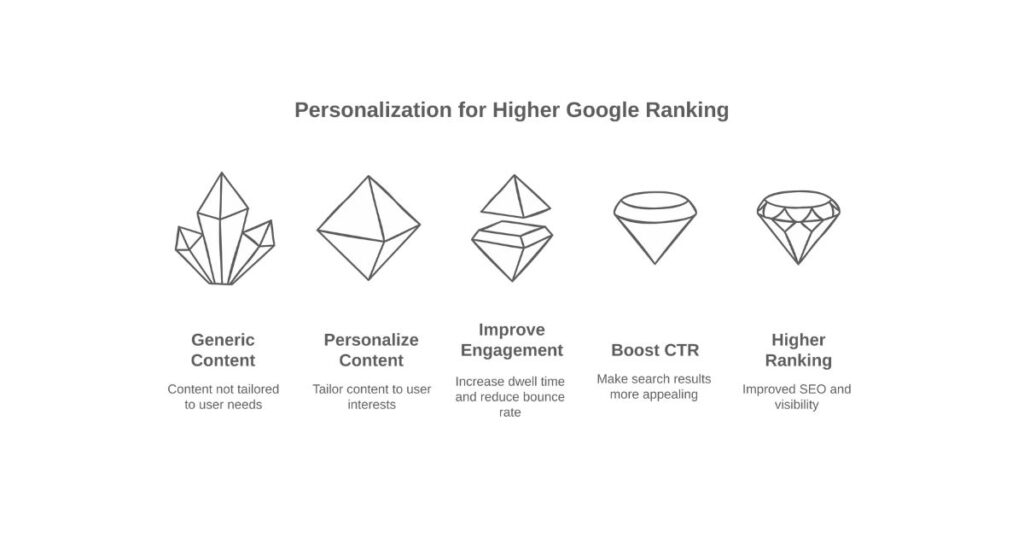
Google examines how people behave once they enter your site. Will they be sticking around? Are they engaging? The longer visitors remain on your site and the more they explore, the more it indicates that the content is valuable. Personalization assists with this, as it directs content toward users who feel relevant from the moment they arrive.
- Dwell Time:
Dwell time is one of the crucial signals, meaning how long an individual stays on the page after clicking through from the search results. Backlinko’s research reveals that top-ranking pages tend to get an average of about 2.5 minutes of dwell time. This sort of engagement tells search engines that something is right with your page. Personalized content goes a long way in keeping users engaged by helping them find whatever it is they came for. - Bounce Rate:
Bounce rate is another vital metric indicating how many users leave after seeing only one page. A high bounce rate could indicate your content was not a fit. However, the more relevant and personalized the landing page headline or recommended content is to the visitor’s intent, the higher the chances that the visitor engages with that page. Studies show that 85 percent of consumers are influenced by home page promotions that are targeted, and 92 percent engage with shopping cart suggestions that have been personalized. It is this kind of affinity and relevancy that gets the visitors into exploring rather than exiting. - CTR:
Then there is the click-through rate (CTR) that begins influencing visitors long before they land on your site. If your search result is catchy enough either by its title or description that specifically speaks to an individual’s need, it becomes far more likely to be clicked. Personalization comes into play here too. Customizing calls-to-action based on user context can increase conversion rates by more than 202 percent. That same relevance increases CTR from the search results creating better chances of visibility for your pages.
Netflix is a great example of this. When users launch the app, it shows a recommendation based on what has been seen before, keeping them engaged for the long run . The same can apply to websites. For instance, a SaaS company could suggest blog posts, product features, or case studies based on an entry’s industry or browsing behavior. Such thoughtful experiences lead to better engagement and stronger SEO signals.
Read: The Basics of Civil Litigation: What You Need to Know Before Filing a Lawsuit
2. Dynamic Content: The Secret Sauce of Personalized SEO
Personalization boosts major SEO signals such as dwell time, bounce rate, and click-through rate; therefore, next comes consideration for its implementation. Dynamic content is the real power that drives personalized experiences.
Dynamic content would mean that there is a difference in content on your site depending on who visits. Rather than everyone seeing exactly the same page, it adapts to them in real time using data like their location, browsing history, and demographics. So if someone from the finance industry visits your website, they might see very different headlines or product recommendations from someone belonging to healthcare. That way, the experience is relevant for the user without much effort from their side.
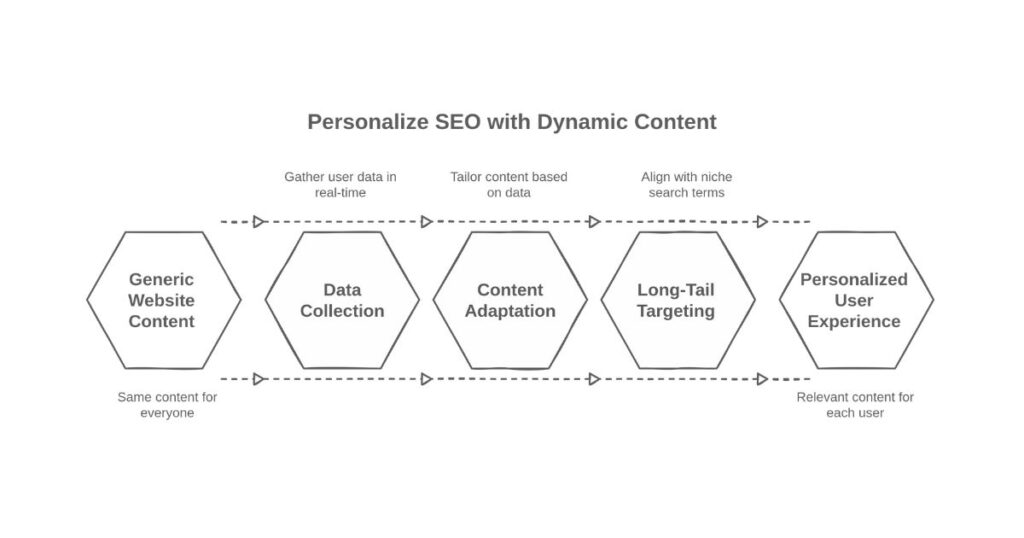
Dynamic content is particularly effective because it’s really helpful for SEO. Its particular strength is in targeting long-tail keywords, which are very niche search terms often indicating the exact intention of a user’s search query. Since it caters to different user intents, your site would be naturally aligned with a large number of searches by making it dynamic.
The figures show the influence evidently. Nearly 80 out of 100 consumers will buy from brands that provide personalized experiences. According to research, businesses that invest in advanced personalization earn around 20 dollars for every 1 dollar spent. The engagement and ROI are largely driven by the fact that they create relevance through dynamic content.
One such classic example is Amazon. A user seeking running shoes sees a host of suggestions different from those referenced by another user looking for hiking boots. These suggestions have been shaped by their search and purchase history. The relevance makes users feel that the experience is engaging with Amazon ranking for a huge array of long-tail keywords.
3. Geographic and Demographic Personalization for Local and Niche SEO
Up till this point, we have explored how dynamic content increases the relevance of a website and enhances SEO performance. Let us now talk about yet another superb layer of personalized experience. Assuming your website adapts not only to what someone is interested in but also where they are or who they are?
Such specific, personalized experiences are now brought forth through geographic and demographic personalization. It helps websites make experiences crisper, especially for local searches or target niches.
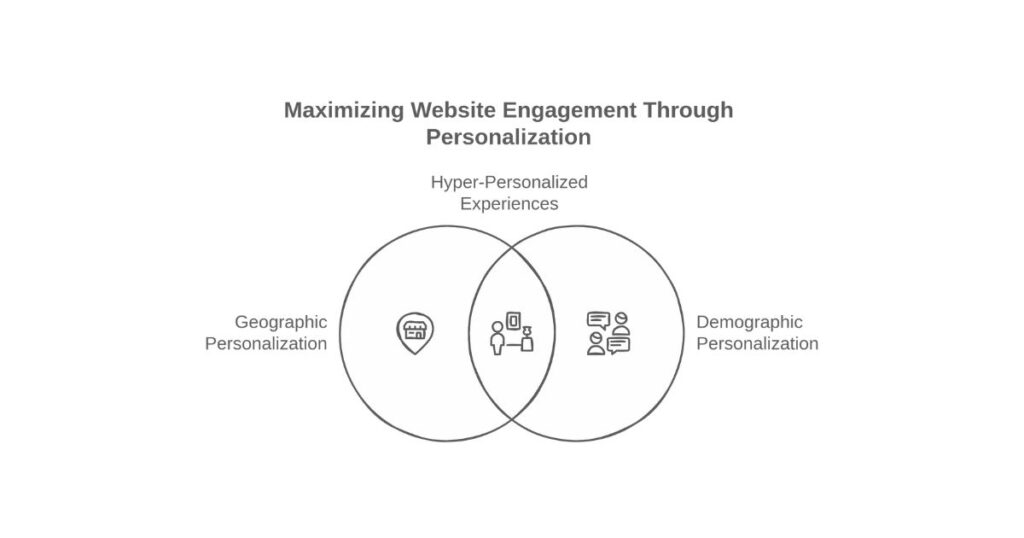
Moving on to the geography aspect, nearly 46 percent of all Google searches are local in nature. If the content of a website tailors itself to information that could be useful for a visitor—such as store hours nearby or local offers—it has instant enhanced usefulness. Such experiences benefit both users and search engines by matching local intent with relevant content.
Demographic personalization works similarly, adjusting what people see based on factors such as industry, age, or interest. A B2B site might show various case studies depending on whether the visitor holds a senior, junior, or intern position or has a particular role in a certain sector. On the contrary, a B2C site could transfer one message into another or offer differentiating product suggestions based on customer preference. This makes the content appear more pertinent to the individual viewing it. Research shows that demographic-based customization of content can increase marketing ROI by five to eight times.
Starbucks serves as a vivid example of both in action. On their website or app, through your location, users are shown the nearest store, local promotions, and some menu sampling. It is easy and personalized without requiring extra effort. Because the information is always relevant, Starbucks benefits from it reducing bounce rates by keeping users engaged within its content.
Be it behavior, location, or demographics, personalization enhances a website’s functionality and engagement. It is based on everything we’ve looked at so far, creating experiences that really speak to users and support stronger SEO performance.
4. The Role of AI and Machine Learning in Scaling Personalization for SEO
Personalization would adapt according to the user’s location and traits; it is time to check how such experiences could scale. Keeping it personal for one visitor is fairly straightforward. But how does one keep it personal when thousands of visitors visit your website every day?
This is where artificial intelligence and machine learning become essential. They allow websites to analyze visitor data in real-time and accordingly shape what each person sees based on behavior, interest, and past interactions. AI presents relevant content that feels timely without requiring manual effort.
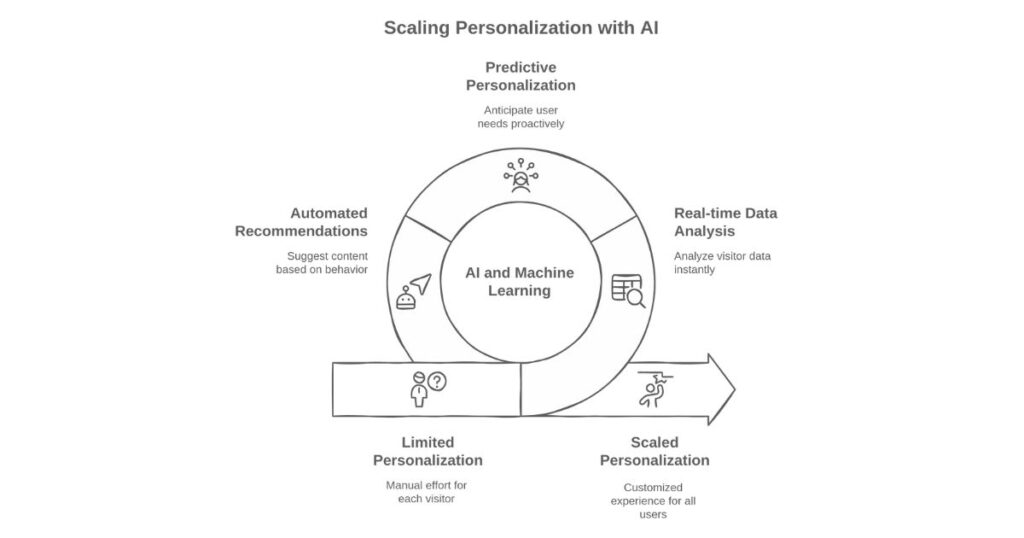
What is even more exciting is how AI predicts what users may actually require before they ask for it; that is predictive personalization. If the visitor is on product pages, the site could suggest a comparison guide or a case study relevant to that industry. If a person comes back from reading a blog, a visit to the site might show them resources that further their inquiry. This very little bit of change makes the experience seamless and engaging. AI’s real strength lies in customizing each visitor’s experience based on different specifications. Such relevance keeps site visitors longer and signals search engines as valuable.
In 2023, the global market for AI in marketing is valued at nearly 41.9 billion dollars and is expected to grow more than 220 billion dollars by the year 2030, demonstrating the pace at which companies are deploying personalization at scale.
Marketing leaders, too, are leaning forward. Nearly 89 percent express that personalization will be vital in business success within the next three years. Over 70 percent say artificial intelligence will redefine how personalization strategies are developed.
A working example is Spotify, which machine learning uses to generate the Discover Weekly playlists, meaning that recommendations are given based on listening behavior in the past. This seems quite customized, although in essence, it is automated. The same methods can be implemented on the web. For example, a B2B may show recommended case studies or blogs based on what a visitor had viewed before. This increases on-site interactivity and helps search engines know that your site is useful and deep.
Closing the loop on concepts we have discussed, AI is unifying everything. It personalizes everything for an individual in real-time, across different types of users, growing along with the audience. From intent comes action; from interest comes engagement; from relevance comes great visibility in search.
5. How to Start Personalizing Your Website
With AI helping deliver personalization at scale, it’s time for action from ideas. Let’s see on how, actually, would could start creating experiences that feels personal while supporting SEO objectives.
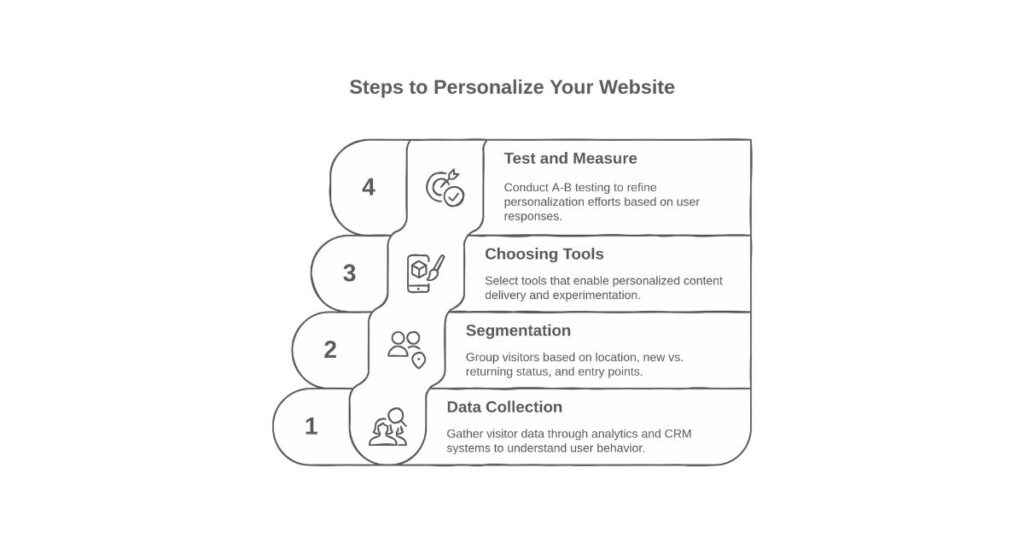
- Data Collection:
It begins with understanding your visitors. First-party data through analytics, CRM systems, or email platforms reveals how people work their way around your site, what catches their attention, and where they leave the pages. This gives you the foundation to create more relevant experiences. In such a survey by Forrester and Collibra, it was found that data-wise organizations are 58 percent more likely to achieve their revenue goals and 162 percent more likely to surpass them, proving how wisely using data can be powerful. - Segmentation:
Next comes segmentation from the data; that is, grouping visitors in meaningful ways-for example, based on their location-they can be either new or returning, or by the way they came to your website.A first-time visitor will see a welcome message, whereas someone returning from a product page on the site could see a case study or testimonial. Although these shifts may seem minimal, they are intended to reduce bounce rates while also increasing the amount of time spent on the site; this positively affects SEO rankings. - Choosing the Right Tools:
So, once you have the basic segments, you must choose a tool that helps you deliver personalized tailored content. The key is finding one that allows experimentation and constant improvement. - Test and Measure:
Evidence always keeps the best personalization on its toes. A/B testing gains insight into what drives better response. For instance, you may want to try different headlines or different layouts with different segments. This helps to fine-tune your efforts around people’s actual behaviors. Currently, 58 percent of businesses are performing A/B testing for conversion optimization, with 35 percent considering adopting it. The increasing use of testing implies the importance of enhancing experience and results.
Consider a company that would use a conversion rate optimization platform like Fragmatic to run a personalization experiment on its homepage, showing ‘different messaging and visuals’ to visitors from the finance and healthcare sectors. Such a simple tweak caused a 15 percent drop in bounce rate for both groups. Small but meaningful. Improved relevance for a stronger experience.
The road to better SEO has remained the same throughout this journey. It begins by understanding your audience through appropriate segmentation and knowing your audience to the right tools and expands by appropriate testing. These are not simply strategies. They are indications to the search engines that your site knows about its visitors and is designed to be helpful to them.
Conclusion
SEO has moved on from simply keywords or some technical tweaks. It’s about delivering meaningful experiences. Personalization, as has been shown throughout this blog, leads to better dwell time and lower bounce rates that keep users engaged-all signals that matter most to search engines these days.
For marketers, the takeaway is simple. Focus on the user, design the journey, and let relevance drive effectiveness. No need to optimize for bots but making it personal for people-that is how meaningful SEO growth happens.
Author’s Bio:
Vidhatanand is the Founder and CEO of Fragmatic, a web personalization platform for B2B businesses. He specializes in advancing AI-driven personalization and is passionate about creating technologies that help businesses deliver meaningful digital experiences.

